The treediagram, which resembles a trunk with branches, shows the hierarchy of tasks and subtasks needed to complete an objective. Learn more at ASQ.org.
With SmartDraw, anyone can easily make treediagrams and decision trees in just minutes. Quick start templates and automation make it the quickest way to produce professional-looking trees.
Our treediagram examples help teams skip the blank page and jump right into structured thinking. From mapping processes to streamlining ideas across departments, these templates offer a head start without compromising flexibility.
Learn about the treediagram, a powerful tool used in Total Quality Management (TQM) to visually represent the relationship between goals, strategies, and tactics. Understand how this tool can help organizations improve their processes and achieve their objectives efficiently and effectively.
Treediagrams in TQM and other controlled systems are a mechanism for structuring logic, brainstorming, and planning graphically. They aid decision-making, project management, and process improvement activities.
ow do you analyze processexecution? The Workflow Analysis Utility provides a ProcessExecution tr. e that is organized by process flow. By using this tree, you can see the order in which events or workflows oc. urred and what caused each to occur. Using the context menu, you can also expand or collapse the tree by right-clicking the tree and .
Understanding what these diagrams are and how to use them can help you divide larger projects into smaller sequential tasks and processes. In this article, we explain what a treediagram is and why you might use one, and explain how to construct this type of diagram to manage workflow.
A treediagram is a way of visualizing all possible outcomes. This guide from MindManager will go over how to create and use treediagrams with examples.
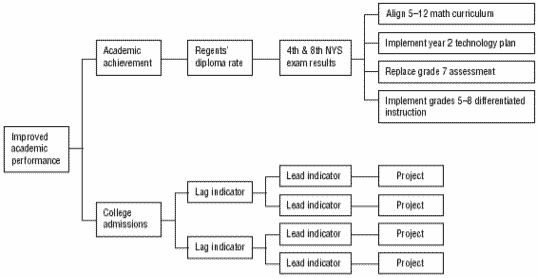 The tree diagram, which resembles a trunk with branches, shows the hierarchy of tasks and subtasks needed to complete an objective. Learn more at ASQ.org.